Your morning run and your PMS tantrums
Why the most disciplined women have the worst PMS
Before we get into this, does any of it sound familiar?
You’re probably more disciplined than most people you know. Running is one of the things you’re most proud of. You feel amazing after a session. You feel strong, clear, like you’ve earned the day. And then 10 days before your period, you don’t recognise yourself. The rage comes from nowhere. You’re crying and you don’t know why. You pick fights and immediately regret them. You feel like you’re watching yourself from the outside, wondering who this person is.
So you run more.
Because that’s what fixes things. It always has. And the more consistent your training gets, the worse your luteal phase becomes.
You've never connected those 2 things.
This is the piece that does it.
This is for you.
I want to tell you a story that I learned a lot later in my journey.
I’m hoping you find it earlier than I did.
A few years ago I started doing these morning HIIT workouts here in Amsterdam. Local version of what F45 or Barry’s Bootcamp is elsewhere. The structure goes like this: 5 minutes on the treadmill, flat out, then you move to the bench where you do about 4 exercises, 5 minutes, rotating through without stopping. Then back to the treadmill. Then back to the bench. You do 4 or 5 blocks of this, back and forth, until you genuinely can’t tell if you’re going to cry or throw up or both.
At the end, you feel destroyed.
But also high.
The endorphins are real and you walk out feeling like you earned something real.
I was going consistently and I was feeling proud of myself for the first time in a long time when it came to movement.
I started losing weight and my clothes were fitting better.
I loved the shape my body was getting.
I finally felt like I’d figured out how to “show up for myself”.
On the outside, everything was working.
But every single month, the 10 days before my period were getting more unbearable.
I didn’t recognise myself in the 10 days before my period.
The anger came from nowhere.
I’d be fine and then I wouldn’t be, and I couldn’t explain why. It felt like living in a foreign body.
Like someone else had taken the controls and I was watching from somewhere slightly outside myself.
I was already deep into studying hormones by this point because of my PCOS. Reading, researching, trying to make the pieces fit. And I couldn’t figure out why things were getting worse when I was doing more.
The thing is… when you start working out, you do it to feel better in your body. Whether it’s for your mood, your mental health, or the way your body physically looks and feels. And you do feel good, in the moment and maybe for a few days right after.
But then 10 days before your period, you feel like crap.
And it comes back every single month.
I learned only later that the thing that was fixing me on the outside was the thing stealing from my cycle every single session.
This isn't in any cardio guide.
Your trainer didn't explain it.
Your doctor didn't either.
Not because it's complicated but because the research was done on men.
The pregnenolone steal (and why your body always chooses survival over your cycle)
There’s a molecule in your body called pregnenolone.
You’ve probably never heard of it. I think most women haven’t. But it’s one of the most important substances your hormonal system works with, because it’s the raw material your body uses to make both cortisol and your sex hormones, including progesterone.
Think of pregnenolone like a pot of money your body has to spend each day. That pot gets divided. Some goes to cortisol, the hormone your body uses to manage stress, stay alert, and mobilise energy. The rest goes to your sex hormones: progesterone, estrogen, testosterone.
The problem is that cortisol gets paid first. No negotiation.
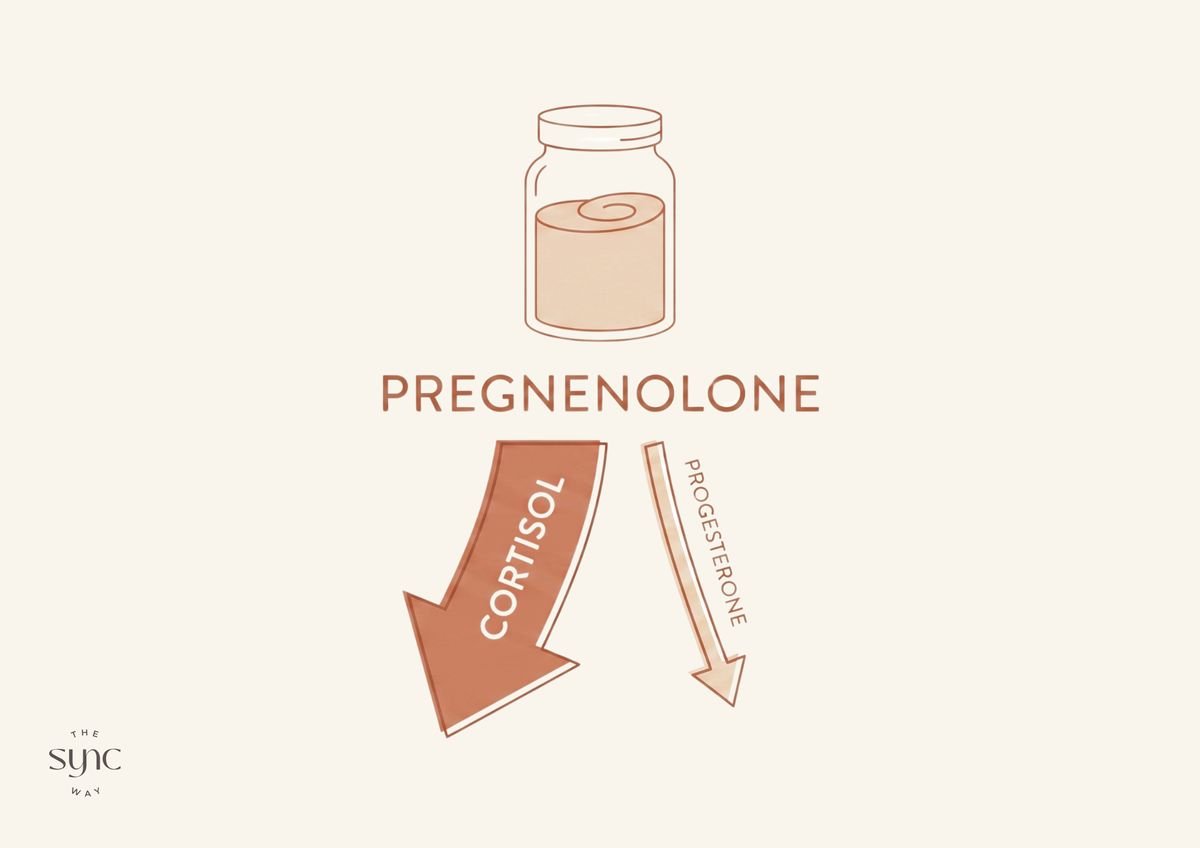
Your body is designed for survival and cortisol is a survival hormone. It keeps you alert and it helps you respond to threat.
Progesterone, on the other hand, (your “pro-gestation“ hormone) supports your luteal phase. It’s the hormone that holds your mood together in the second half of your cycle, that keeps you feeling regulated, that makes the 10 days before your period “liveable”. It matters so much!! But your body will always prioritise survival over pregnancy.
So when cortisol demand is high, pregnenolone goes there first.
And progesterone gets what is left.
This is called the pregnenolone steal. And intense cardio, usually done without adequate fuelling, triggers it every single time.
Here’s what was actually happening to me in that bootcamp.
Every session, I was running hard enough to spike my cortisol. Then moving straight into high-intensity interval work. Then back to the treadmill. 4 or 5 blocks of this, 3 to 4 times a week. And I was going in fasted, cause these classes were at 7am. Empty stomach, because that’s what you do in the morning, right? You train, then you eat. It feels like you “earned” that meal.
Each session was a cortisol event.
Each one pulled pregnenolone away from my sex hormones. And because I wasn’t eating beforehand, my body had no fuel available. So it had to produce even more cortisol just to get glucose from storage to give me fuel to actually finish the class.
And by the time my luteal phase arrived, there wasn’t enough pregnenolone left to support the progesterone my body needed.
That is why the rage.
That is why the mood swings.
That is why becoming someone I didn’t recognise for 10 days every single month.
But my body was DOING EXACTLY WHAT IT WAS DESIGNED TO DO.
It was choosing cortisol over progesterone because cortisol is what keeps you alive.
My cycle was “the collateral damage” of a body doing its job perfectly in the wrong environment.
And here’s the part that still gets to me when I think about it.
This isn’t rare.
I still see it constantly in the woman who loves cardio.
The woman who’s disciplined.
The woman who shows up consistently and genuinely loves working her body hard.
But she isn’t doing something wrong. She’s doing something designed for a different hormonal profile, built on research done almost entirely on men, and wondering why it keeps making her feel worse.
The good news is that this is fixable.
And you don’t have to stop running to fix it.
What to change without quitting your run
It’s Sunday morning as I write this section. My matcha is going cold next to my laptop. I’ve done my drainage work, the 6 nodes and a quick colon massage, cause I’m in my luteal and I woke up so bloated. I haven’t trained yet today, I wanted to finish this piece first.
I still love movement and I still go hard in my sessions.
The difference is that my luteal phase no longer feels like a torture.
What changed wasn’t only the training.
It was 4 things I did around it.
And I know what some of you are thinking right now.
You’ve been running for years and you feel fine. Maybe. Or maybe you’ve been normalising feeling like crap every month without realising there’s another option.
Either way, here are the 4 things.
The goal isn’t to make you afraid of cardio.
What we’re changing is the hormonal cost of how you do it.
#1 Never train fasted
When you go into a session without food, your blood sugar is already low. Your body has to produce cortisol to mobilise glucose from storage before the training cortisol even begins. You arrive to the session “hormonally behind” before you’ve done a single rep or run a single step.
I’m not asking you to eat a full breakfast before a 6am run. I’m asking you to eat something small (half a banana, a few dates, a small pot of yogurt). Something that tells your body that resources are available before you ask it to work.
#2 Replace one HIIT session per week with resistance training
Just one swap.
Here’s why this matters so much for cortisol.
Resistance training does something that cardio doesn’t. When you do it consistently over time, it teaches your stress response system to become more efficient, more precise, less reactive. Instead of flooding your body with cortisol every time it’s challenged, your system learns to produce the right amount for the right situation and stop there.
The result is lower cortisol across the day.
And lower cortisol means more pregnenolone available for progesterone. Win win win!
I wrote a full article on strength training and hormones. It’s a gem! One of the most popular articles here on Substack.
And if you don’t wanna miss similar articles, don’t forget to subscribe to my Substack.
Ok, number 3 is this…
#3 Eat within 30 to 60 minutes after every session
The cortisol spike from training is normal, it’s designed to be there. The problem isn’t the spike. The problem is the unmanaged spike that stays elevated because your body has no signal that the work is over and resources are available.
Food is that signal.
This is what tells your body it can calm down.
Note: If you train in the evening, eat within 30 minutes of finishing. Not an hour later when you finally sit down. Dr. Stacy Sims, who researches female-specific exercise physiology, is explicit that the post-workout meal after an evening session matters more than the concern about eating late. Adjust the portion but eat every single time.
#4 Let your luteal phase be the measurement
You don’t need a hormone test to know if this is working because your luteal phase will tell you everything.
After you make these changes, track the 10 days before your period for 2 full cycles. Just notice: how’s the mood? How’s the anger? How’s your ability to feel like yourself in your own body?
If the progesterone picture is improving, you’ll feel it.
And if you want to work through this with a community of women doing the same thing, this is what we do inside The Sync Way on Skool. 🔗 You can join us here
Bottom line
- Cardio isn’t the enemy. The enemy is cortisol without proper management
- Pregnenolone gets split between cortisol and your sex hormones. Cortisol always goes first
- Less progesterone gives you more intense PMS symptoms
- Fasted training is the highest cortisol cost with the lowest hormonal return. Even half a banana changes the equation
- Your luteal phase is the measurement, just 2 cycles will tell you more than any hormone panel
And lastly, send it to the woman in your life who runs every day and falls apart before her period. She needs this more than she needs another cardio session.
Love, Teo
P.S. I spent years trying to decipher my PMS and I always ended up saying that I was just “too much”, unstable, too emotional, too reactive, too sensitive. Nobody told me that my workouts were actually taking too much. If you’ve ever talked yourself out of your own symptoms, this piece is the one I wish I’d read back then.
← Back to all articles