The woman who can smell bullshit from across the room
What your luteal phase is actually trying to do for you
When the average person thinks about the menstrual cycle, they think about the period, the menstruation, the bleed.
*rolling my eyes*… because, my love, that’s just one page of a very long book.
Your brain chemistry completely changes across one full cycle. And it’s not just one small change, everything changes. The way you process information, the way you read people, the way you interpret what’s happening around you, all of it shifts depending on where you are in your cycle. Your reality is literally filtered differently depending on the week.
And because we don’t know this, we think we’re crazy.
You’re looking at the same person, same situation, same interaction, but it feels like it’s from a completely different movie.
No wonder most women experience this as chaos.
But what I want to do with all my research, and the content I translate it into for you, is show you how to use this brilliant divine design as a weapon.
Because if it can stir up those intense emotions every single month, imagine what you can do with it once you understand how to channel it the right way.
Why is everyone complaining about the luteal phase?
I used to dread it. I would always end up apologizing for the mess I created around me during those days. She felt like an uncontrollable force. At least I thought she was.
Today she is my best therapist, my most honest friend, my clearest connection to myself. She shows me things nothing else can. She surfaces what I’ve been avoiding, names what I’ve been tolerating, and hands me information about my own life that I genuinely cannot access any other week of the month.
She’s just wildly misunderstood.
Because we keep comparing her to ovulation, to the follicular phase, to the weeks where everything feels easy and light and possible. And of course she loses that comparison. But that’s not what she’s here for.
One week a month your brain is configured to see through everything. The filter comes off. The things you’ve been softening and managing and giving the benefit of the doubt become impossible to look away from.
You smell the bullshit from across the room.
That is therapy on steroids, if you know how to use it.
And the women who actually get it, who stop fighting it and start working with it, they move through the world completely differently.
Let me show you how.
What the brain science actually says
I’m not asking you to take my word for it.
I read the papers and I translate them so we can all use this knowledge and actually apply it in our lives.
Three studies scanned women’s brains across their cycle. What they found is not in any “how to live in a female body” manual. It should be.
01. Your brain turns inward
(before you jump and say this is heavy, just look below each science paragraph. I translate the science into something you can actually use)
The first one scanned 60 healthy women across three cycle phases. What they found: the default mode network, the part of your brain responsible for self-referential thinking, for turning inward, for introspection, reaches its highest complexity during the mid-luteal phase. At the same time, the dorsal attention network, the one that keeps you focused outward, on tasks, on other people, on performing, drops.
Your brain literally turns its most powerful network toward yourself.
Think about what this looks like on a Tuesday.
Week two, you’re in a meeting, fully present, contributing, reading the room, following five different conversations at once. Week three, same meeting, same people, and you’re somewhere else entirely. You’re thinking about that thing he said last week. You’re wondering if you’re in the right job. You’re replaying a conversation from three years ago that has nothing to do with what’s on the agenda.
That’s your brain’s attention network physically shifting direction. It stopped looking out and started looking in.
02. Brain synchronisation on steroids
A second study tracked one woman across her entire cycle and measured how information flows across the whole brain. The luteal phase showed significantly higher information transmission across brain networks at long distances. The default mode, the salience network, the attention and control networks, all of them showed increased synchronisation during luteal.
When she went on hormonal contraceptives, it all disappeared.
Think about what this means.
When you feel everything more intensely in week three, and you pick up on the energy in a room, and you clocks the thing nobody said out loud, and you can’t stop connecting dots at midnight… That’s your brain running more networks in sync than it does any other week of the month.
03. Your past and your judgment start talking
A third study tracked women across four full cycles and found that progesterone specifically, not estrogen, increases connectivity between the prefrontal cortex and the hippocampus. The prefrontal cortex handles decision-making and emotional regulation. The hippocampus handles memory.
When progesterone rises, these two start talking more.
This is why old memories surface in the luteal phase. Suddenly you’re thinking about the relationship that ended two years ago, or the way your mother said something when you were 12, or the friendship that faded without explanation and you never really dealt with it.
That’s your memory center having a direct line to your judgment center for the first time all month. Your brain is filing things and it’s connecting things.
It is asking: have we actually processed this, or did we just move on?
The luteal phase is handing you things you left unfinished.
Put all three studies together and here is what you get.
In the luteal phase your brain turns inward, transmits more information across more networks simultaneously, and increases the channel between memory and judgment.
The science calls this increased dynamical complexity.
You call it your worst week.
But in reality… it’s actually your most misused one.
Your luteal brain is your ally
Nobody frames this correctly.
In your luteal phase your brain doesn’t get worse. It gets sharper in a very specific direction.
GABA drops, which means the chemical that keeps your reactions contained loosens. Your amygdala, the part of your brain that scans for threats, becomes significantly more reactive. Serotonin drops too, so that mood stabilizer, the “everything is fine” chemical, is gone.
And what’s left is you, unfiltered.
For one week you are perceiving everything at full volume. The micro-expression he made, the friend who said something that felt slightly off, the situation that’s been fine on paper but has never felt quite right. All of it surfaces. All of it becomes impossible to look away from.
Nothing in your environment changed.
Your filter did.
Now add the science and here is what you actually have: a brain that has turned its full attention toward you, running more networks in sync than any other week of the month, connecting memory to judgment, pattern to meaning, feeling to fact, with the chemical filter completely removed that was keeping you polite and agreeable and fine with things you are not actually fine with.
This is the most sophisticated threat system ever built!!
And it runs on a schedule, every single month, whether you use it or not.
How to use it
The filter is off, so here is how to use it.
In your relationships
The thing that is suddenly unbearable about him has been there the whole time. You just had a filter on it. The luteal phase didn’t create the problem. It removed your tolerance for it.
So instead of reacting to the symptom, get curious about the pattern. Is this the third month in a row this same thing has come up? Because if it is, your body is not overreacting. It is highlighting something you keep filing away.
The women who use this well don’t blow up their relationships in week three. They collect evidence. They notice the pattern and when the follicular phase returns, they have a very clear, very calm conversation about something they now understand deeply because they’ve been watching it for months.
In your friendships
The friend who suddenly feels like too much effort. The group chat that’s draining instead of filling you. The person you keep making time for who never quite shows up the same way.
Your luteal brain is reading reciprocity at full volume. It is scanning every relationship for the same question: is this actually good for me?
Don’t end the friendship in week three. But do take the feeling seriously. Because a friendship that feels off every single luteal phase, without fail, is telling you something your follicular self is too generous to admit.
In your work
The job that feels suffocating. The project that feels pointless. The meeting that makes you want to disappear.
Two weeks ago you were fine with all of it. Now you’re not. And you’re wondering which version of you is telling the truth.
Both are, but they’re telling you different things.
The follicular version tells you what you can tolerate.
The luteal version tells you what you actually want.
The gap between those two things is worth writing down.
In yourself
This is the one most women skip.
When the filter comes off, you don’t just see other people more clearly. You see yourself. The version of yourself you’ve been maintaining for everyone else’s comfort. The need you haven’t named because naming it would require doing something about it.
The luteal phase has no patience for the performance.
Whatever surfaces about yourself in this window, the desire you’ve been minimising, the boundary you keep not setting, the version of your life that keeps showing up in your head when everything goes quiet, write it down.
And while your brain is doing all of this, your nervous system is running the tab.
Which is why what you do with your body in this window matters as much as what you do with your mind.
Ok, let’s get practical a bit…
The 30 minutes self-care stacking
I love pampering my body but I have about 30 minutes to myself most days. Maybe you do too. And in the luteal phase those 30 minutes matter more than any other week of the month because your nervous system is working harder than it looks and it needs something back.
I supercharge my pampering time, feet to head, literally.
Hair mask goes in first. I’ve been using the 🔗mask from Scandinavian Biolabs. I also use their 🔗growth routine, 🔗oil and 🔗serum. My hair is so much fuller, thicker and nourished (they are our official partners and they offer our community 20% off with code THESYNCWAY).
While it sits I run the bath with Epsom salts. Currently using the one from 🔗Holland & Barrett. Magnesium through the skin, directly into a nervous system that has had its brake pedal loosened all week.
While I’m in the bath I do the 6 nodes sequence to open up the lymph nodes (we do this so often inside our 🔗community on Skool. Come inside, I would love to properly meet you!!! We do lots of challenges and calls, and meet-ups there)
And I also use a scalp massage comb. Circulation, parasympathetic activation, and it forces a specific kind of slowness that nothing else really replicates.
Then I pick up whichever book I’m pulled toward that week. Three I come back to every luteal phase.
- A Return to Love by Marianne Williamson when fear is loud.
- The Untethered Soul by Michael Singer when the thoughts won’t quiet.
- Teach Only Love by Gerald Jampolsky when everything feels like a threat and I need something to recalibrate fast.
Thirty minutes. Everything stacked.
It’s maintenance on the most sophisticated detection system you own.
Treat it accordingly.

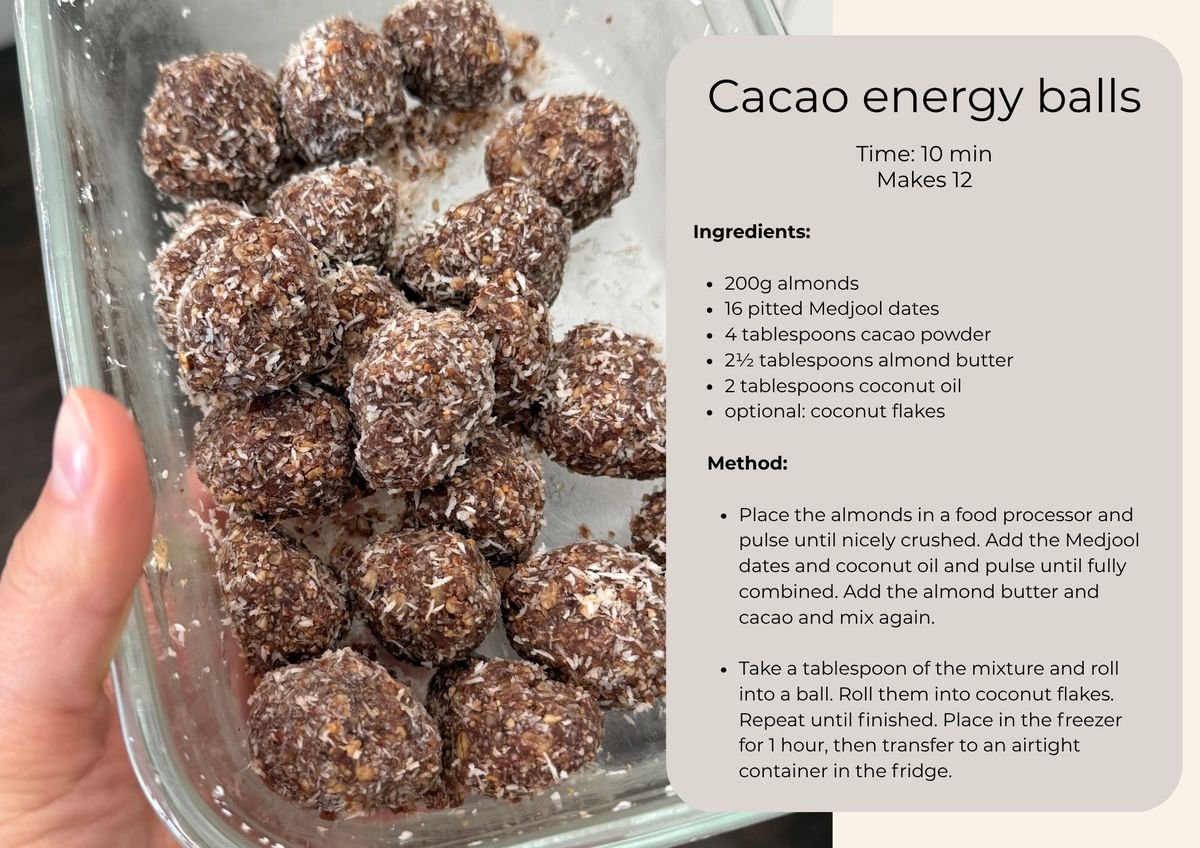
Ohhh and before I forget, I have to share this recipe with you. I make this on repeat during luteal, cause it’s fast, and sooo easy! And it keeps her satisfied during the day.
One last thing
Most women spend this week waiting for it to be over.
The ones who get it spend it paying attention.
There is a version of you on the other side of understanding this who doesn’t dread the week her filter comes off anymore.
She finally learned to trust the week everyone else is trying to survive.
Love, Teo
The research papers mentioned:
- Avila-Varela et al., npj Women’s Health, 2024
- De Filippi et al., Frontiers in Neuroscience, 2021
- Arélin et al., Frontiers in Neuroscience, 2015