You researched your way into staying sick
On information overload, identity capture, and the foundation nobody talks about
I was diagnosed with PCOS about 15 years ago.
And back then, I didn’t have any of this. Back then, there was no algorithm feeding me content about my condition and no community of thousands of women swapping symptoms and tips and tricks, no personalised rabbit hole designed to pull me deeper the longer I stayed in it and definitely no ChatGPT or Claude to help me make sense of my condition.
I just got the diagnosis, went home, and got on with my life.
Which sounds like a bad thing. Like I wasn’t taking it seriously.
But the older I get, the more I think it was actually one of the reasons I didn’t stay stuck in it and the reason I managed to reverse it.
Because I never really identified with having PCOS. I knew it was a condition I had, the same way you know you have flat feet or a vitamin D deficiency. It was a piece of information about my body, not a description of who I was. I never introduced myself through it and I never built a community around it. I never spent hours reading about what it meant for my future. It was just... a thing that was true, that I needed to understand well enough to address.
Now I watch women get diagnosed and within a week, the algorithm has made it their whole personality.
The feeds, the forums, the symptom tracking apps, the content loop that serves you more of whatever you already engaged with. It’s designed to keep you inside it, not to help you heal.
And I want to be clear: I’m not judging this. I understand why it happens. When you’re confused and scared and your body doesn’t make sense, the community feels like safety. I literally created the entire Sync Way universe as community-first space. If there is someone who understands the power of community, it is me.
But the catch is this one… information feels like control. The more you know about something the more in control you feel (at lest at first).
And there is a real cost to over-identifying with a condition that nobody is talking about.
When the condition becomes who you are, getting better starts to feel like losing yourself. And that, quietly, makes recovery so much harder than it needs to be.
Here’s a concrete example of what that actually looks like.
We use PCOS fr the sake of keeping this thread consistent, but this could be ANY condition at all. You read about PCOS and somewhere in that reading, you find out it’s linked to infertility. That’s a clinical correlation, you found a statistic in a study. But the moment you identify as a PCOS person, that statistic stops being clinical and it becomes YOURS. You stop reading it as “some women with PCOS experience fertility challenges” and start reading it as a risk that belongs to you specifically, because that’s what the label now does. You are the PCOS so the risks are yours too.
And then you read more and you find more connections, more complications, more things that might also apply to you. Each one gets absorbed not as information about a condition, but as information about who you are.
What nobody tells you is that the beliefs you hold about your body are not neutral. They don’t sit quietly in the background while you get on with things. They shape every micro-decision you make, the way you talk about your body, the way you interpret a symptom, the way you respond to a setback. They determine whether you move toward healing or toward confirming what you already believe. And most of the time, you don’t even notice it happening.
That’s exactly what makes it so hard to see, and so important to name.
This post is going to be confrontational for some of you, so I want you to relax into this piece, and read it with an open heart, don’t block it. We have a comments section where I would love to hear your perspective. It’s a conversation, let’s keep it conversational.
The thing nobody tells you about having unlimited access to information
Here’s the paradox.
We have access to more health information right now than any generation before us. We can find answers to almost anything within seconds. We can connect with specialists, read peer-reviewed studies, find women with our exact symptom profile on the other side of the world. In theory, this should mean we’re the healthiest, most informed generation of women who ever lived.
And yet…
I talk to women every single day who have read more about their hormones than most doctors know, who have tried more protocols than I can count, who are doing everything right by every metric they can find, and who still feel like garbage. More informed than ever and no better than before.
Here’s what I think is happening, and I see it show up in 3 specific ways.
Problem 1: More information creates more confusion, not more clarity.
Every answer you get online opens 3 more questions and every protocol you read about has a counter-study. And then, every expert you follow contradicts another expert you also trust. And at some point you look at your notes and your tabs and your highlighted books and you realise that everything you know is just a tiny fraction of everything that exists on this topic, and the fraction doesn’t get bigger the more you read. It just keeps revealing how much more there is.
That is a very specific kind of panic that I don’t think has a name, but I know you’ve felt it.
Problem 2: The algorithm turns your condition into your identity.
And then, on top of that overwhelm, there’s the identity layer.
You get diagnosed with something, or you identify a pattern in your body, and the algorithm immediately serves you a community built around that thing. Suddenly you’re not just someone who has irregular periods. You’re a PCOS girlie. You entered the hormone dysregulation space (maybe that’s even how you got here, on this page hehe love you). You have a label, a tribe, a content feed that reflects your condition back at you every single time you open your phone.
And this is where it gets complicated, because community is genuinely valuable.
Understanding your condition matters but there’s a line between understanding something and becoming it.
When you become your diagnosis, something subtle shifts in how you relate to the possibility of feeling better. Getting better stops being a simple goal and starts feeling like a kind of identity threat.
If your whole feed, your whole community, your whole sense of self is built around this condition, what happens to all of that if the condition resolves? Who are you on the other side?
I’m not saying this is conscious because it’s almost never conscious. But I’ve sat with enough women to know that this shift happens, and that it slows things down in ways that are hard to trace.
Problem 3: There’s a gap between knowing and doing that gets wider the more you read.
There’s also a more practical problem that lives underneath all of this.
There’s a huge gap between reading and understanding something and actually being able to use that information. And the more you read, the wider that gap gets.
Take endocrine disruptors as just 1 example. Once you start understanding how hormones work, you also start understanding what disrupts them, and then you realise the list is basically everything. The perfume you’ve worn for years, your facial cream, your shampoo, the cleaning products, the detergent, the plastic cutting board, the Tupperware you’ve been microwaving food in for a decade. Everywhere you look, something is in the way.
So the logical move, especially when you’re in a dark period and just want to feel better, is to throw everything out and start completely fresh. Full overhaul.
But you can’t live like that.
Because you’ll come across another topic and realise you need another “clear start” another “reset” button.
The harder you try to fix everything at once, the more paralysed you become. And every single time you finish a protocol, a cleanse, a 21-day reset, a biohacking experiment, your body goes right back to where it started. Like you had never done it at all.
So what does the body actually respond to?
*Caveat: What I’m about to tell you next is informed by my own independent research and actual observations in my practice.
The body doesn’t respond to information.
Your body responds to what you do every single day.
And most of what women are doing, including what I was doing for years, is trying to work on the wrong part of the system first: usually… the diet.
But here’s an important aspect that gets overlooked way too many times.
Your body has a drainage system that works in a very specific sequence. 5 levels: cells drain into tissues, tissues into lymph, lymph into the liver, liver into the colon. The colon is the exit. When those exits are slow, everything your body has processed and packaged for removal has nowhere to go. So it recirculates and it sits in your tissue. And it shows up as the symptoms you’ve been researching: the bloating, the puffiness, the breast tenderness, the brain fog that no amount of coffee touches.
Most protocols and “diets” work at the top of this funnel. They mobilise things, stimulate things, get waste moving but they skip the part where you “open the exits first”.
So the waste moves and then it hits a wall.
This is why cleanses make so many women feel worse before they feel better. And why “feeling worse first” got rebranded as a healing crisis instead of being called what it actually is: A TRAFFIC JAM. You stirred everything up before the exits were clear.
No amount of research tells you this because the research is almost always about the protocols, not about the order.
The 1 thing that worked (for me)
If there was ever a best guinea pig for everything that doesn’t work, it was me.
I lived 4 years as a vegetarian, tried every amino acid protocol I could find, 21-day biohacking experiments, intermittent fasting for 1 year, superfoods, elimination diets, supplements stacked on supplements. I tried so many things to help myself feel better that I genuinely lost count. And I had real moments of improvement with some of them, real windows of feeling good, before my body would quietly go back to baseline and I’d start again.
If I brush off all the noise now and ask myself what the 1 thing was that actually moved everything for me, there’s only 1 honest answer.
The gym.
I locked in and I got serious about it. I went consistently, 6 days a week, no exceptions. And what happened was not what I expected because honestly… the reason I started working out was to get fit…
But I ended up feeling something s unexpected…
I would wake up in the morning with no brain fog. I didn’t recognise myself. I was sharp first thing, clear, present. My face stopped being puffy and my legs, which I had hidden for years, literally years, I didn’t wear shorts until my early 20s because my legs were always so swollen and heavy that I was embarrassed by them, my legs changed. I could look at them and not want to cover them immediately. I started having bowel movements every single morning and I started sweating properly in saunas for the first time. My periods were still painful and irregular for a while, but they became better and better over time.
I didn’t fully understand why any of it was happening while it was happening, I just knew something had fundamentally shifted.
And here’s the part I want you to sit with for a second: we live sedentary lives. I know that’s not what anyone wants to hear. But whether you want to admit it or not, most people reading this spend the majority of their day sitting: in front of a screen, on their phone, in a car, at a desk. We’ve engineered almost all natural movement out of daily life and replaced it with maybe 3 gym sessions a week if we’re motivated enough, and then we wonder why our bodies aren’t clearing properly.
Look at your steps for today and be honest with yourself. Most of us are not moving anywhere near enough to keep our drainage system functional. And that is the part nobody is talking about.
Now I can connect the dots exactly.
Every muscle contraction pumps your lymph. Your lymphatic system has no heart pushing fluid through it. Muscle movement is the only pump it has and when I started moving every day with that level of consistency, my drainage system woke up and “the exits opened”.
Everything that had been sitting in my tissue, the waste, the recirculated hormones, the fluid that had been pooling in my legs and face for years, finally had somewhere to go. Everything downstream improved because for the first time, the foundation was actually doing its job.
And then something else shifted that I didn’t expect: my relationship with food changed completely. Once I was training seriously, I stopped chasing restrictive approaches: no more vegetarian experiment, no more elimination diets, no more superfoods stacked on superfoods hoping something would stick. I started understanding what my body actually needed to function, not just to be clean or pure or whatever wellness had convinced me to aim for. Eating enough protein felt important for the first time, not optional. I started fueling properly and that changed everything again, in a completely different direction than any diet I had tried before.
The 1 thing that can work (for you)
I want to be clear about something: I am not telling you to go to the gym 6 days a week. I know that’s not where everyone is starting, and I know it because I tried. I told my closest friends all the reasons they should be lifting heavy and going consistently, laid out the whole argument, and it still didn’t happen. Because it’s not about the argument. It’s about readiness, capacity, and having the right steps in place before you get there.
The gym was the thing that worked for me in my specific situation, with the specific body and life I had at the time.
It opened the exits. That’s how I understood it later, after I started connecting the dots.
But once I saw what was possible when the drainage system actually starts moving, I became obsessed with finding out: what other ways can we get there? What if someone can’t do 6 days a week? What other techniques work directly with the lymphatic system, the actual nodes, the organs themselves? How do we open those exits without making the gym a prerequisite?
That question is what took me back to school.
I became an integrative health practitioner, specialised in menstrual health, and spent years sitting with hundreds of women in the exact same confusion I had lived in. And in that process, I became obsessed with why good habits don’t stick.
And I realised again… the information was never the missing piece, the sequence was.
A habit has to be established before it can be improved. You have to standardize before you optimize.
The women who come to me wanting to cycle sync, wanting to eat for their luteal phase and track their follicular windows, are trying to optimize a system that has never been standardized. Their elimination is inconsistent, their sleep shifts by hours between weekdays and weekends, they’re layering a complex hormonal protocol on top of a body still running in chronic low-grade stress, and wondering why nothing holds.
You cannot optimize what has not been stabilized.
That’s what led me to the Big 4 which is built on 4 levels for a specific reason. It’s not a protocol, it’s a sequence. Each layer builds on the one before it. I mean, the order is the entire point.
And the entry point, for every woman regardless of where she is, is the same: open the exits first.
The clear challenge: 7 days, no research required :)
We’re almost at the end of this article and I’m so curious to hear what you think, so please drop your comments, would love to hear from you… But before we go I have something for you.
That’s the Clear Challenge.
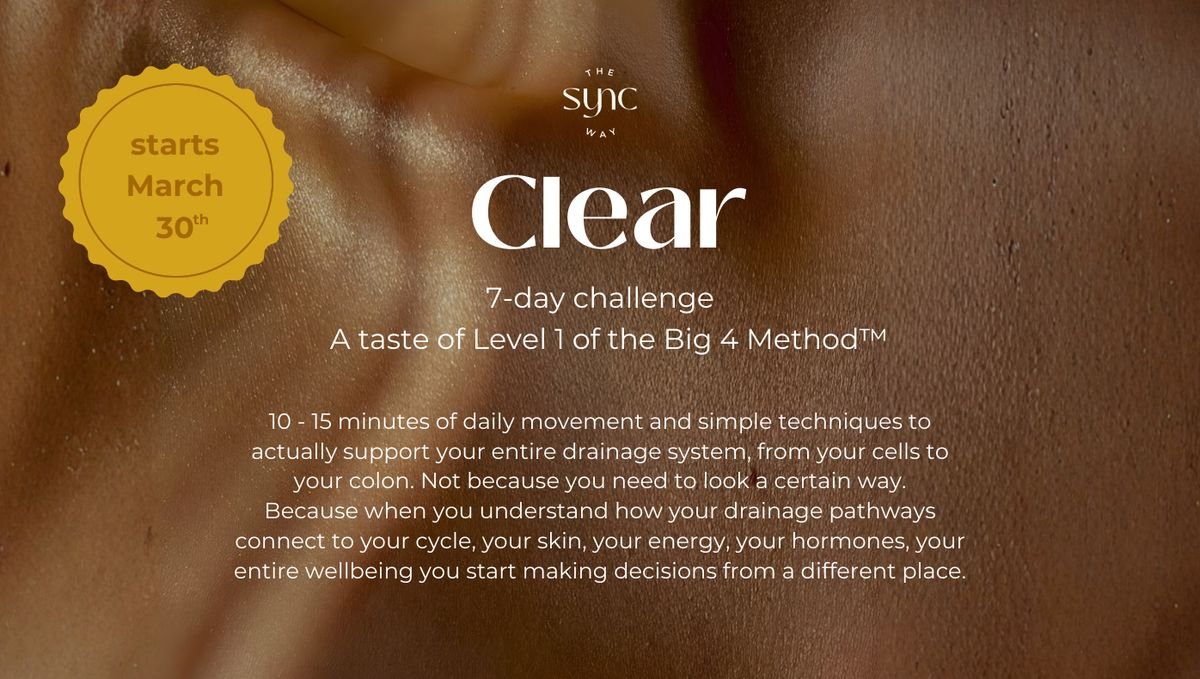
We actually ran a version of this in February, for 2 weeks, inside my community. And the results were clear enough that I wanted to bring it back, condense it, and open it up more broadly.
The Clear Challenge is 7 days built around 1 idea: open the exits before you do anything else.
We do that through 3 things working together:
- Drainage work, to physically move what has been sitting stagnant in your lymph and colon.
- Nervous system work, because your body cannot clear properly when it’s running in fight-or-flight, and most of us are in low-grade stress mode from the moment we wake up.
- And warmth, warm drinks in the morning and warming foods through the day, because a cold, contracted body does not drain.
These 3 things together create the conditions your body needs to actually do the work it already knows how to do.
Nothing in this challenge requires a new diet, a supplement order, or clearing your schedule. The morning practices take under 15 minutes.
What you’ll notice over the 7 days is not dramatic. It’s quiet and specific and yours, but just see what shifted for the women doing this program back in Feb.
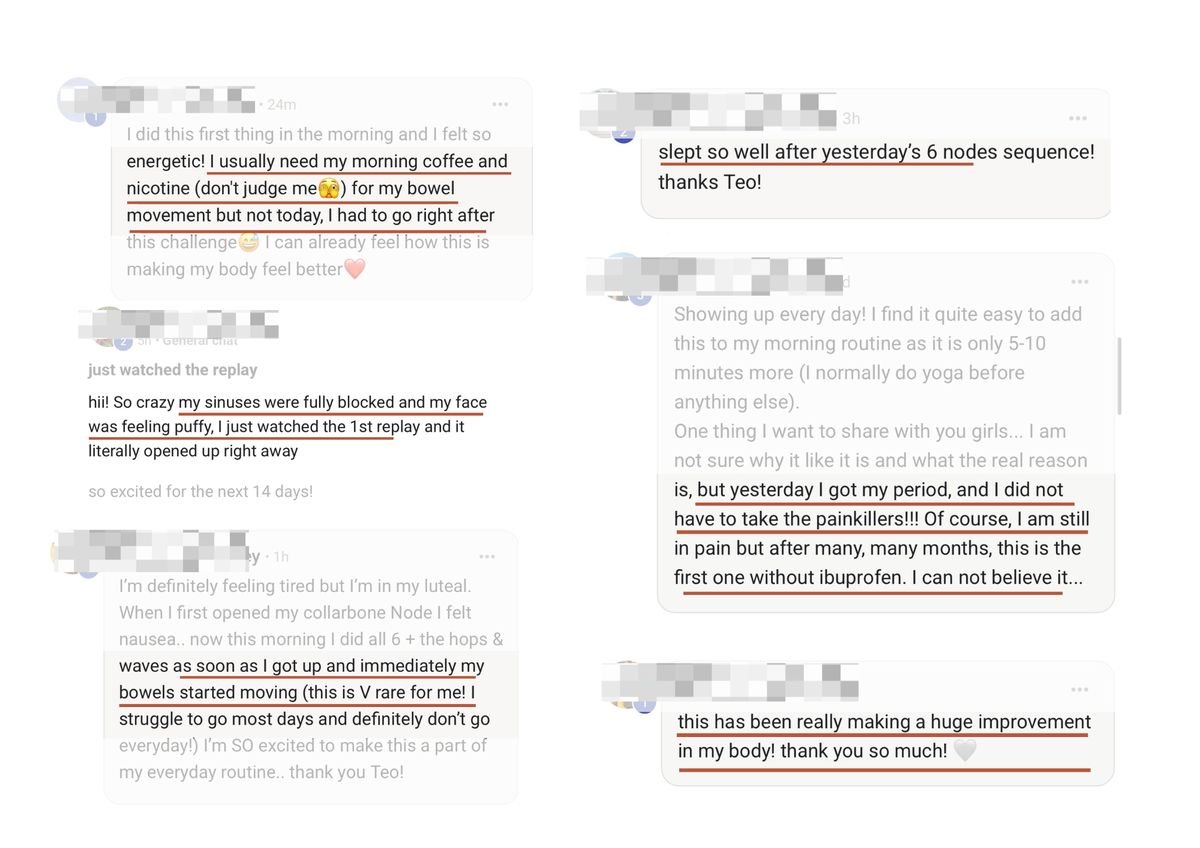
I’m inside the Skool community every day during the challenge. Each practice comes with a short explanation of the physiology behind it, because you’re not someone who does things on faith (I know that about you by now). You want to understand what you’re doing and why, and for women like us, that’s what makes it stick.
I think you’ll love doing this together with the girls! It’s really special when we do it all together.
Just one last thought…
15 years ago, not having the algorithm might have been the thing that accidentally protected me from becoming my diagnosis.
But you don’t have that luxury now... the feed is already there and the content loop is already running.
What you can choose is where you put your attention next.
(hope to see you inside the Clear Challenge)
Love, Teo
← Back to all articles