Why your body is inflamed (and it has nothing to do with food)
Why drainage comes before everything else you’ve tried
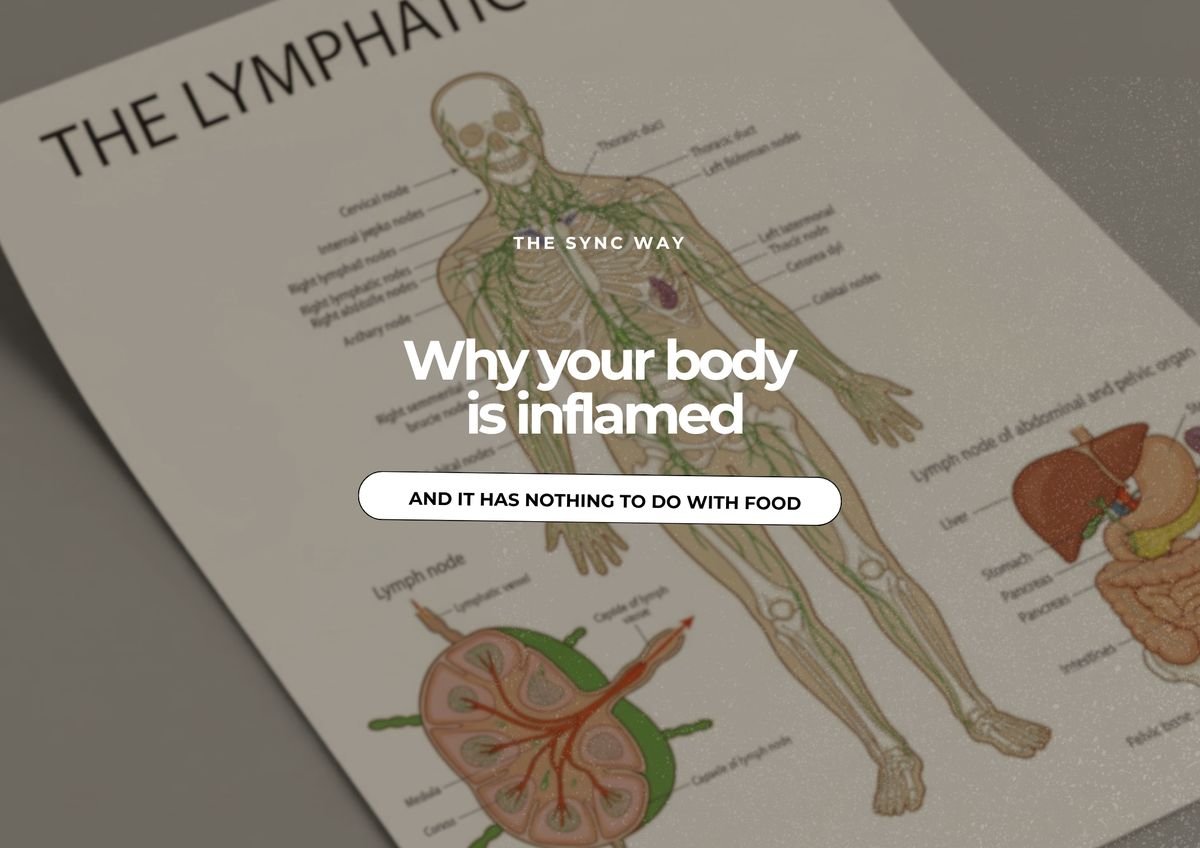
The anti-inflammatory diet isn’t wrong.
It’s just step 3.
And nobody told you what steps 1 and 2 are.
You’ve probably already tried the diet. You’ve cut out dairy and gluten and sugar, added turmeric to your smoothies, stacked your shelf with omega-3s and magnesium, started drinking things that are green. You’ve done all the things that are supposed to reduce inflammation.
You’re still waking up puffy. Still bloated by afternoon. Still exhausted in a way that 7 hours of sleep doesn’t fix. Still looking in the mirror and wondering what you’re missing.
You know the signs and maybe you’ve been living with them so long they feel normal.
- Puffy face every morning
- Rings that don’t fit before noon
- Bloated before you’ve eaten anything
- Dull skin or breakouts on your chin
- Stiff joints when you wake up
- Brain fog that coffee doesn’t fix
- Feeling heavy for no clear reason
- Tired even after a full night’s sleep
None of this is normal. It is common, and it is FIXABLE.
The reason most women stay stuck here isn’t because they’re not disciplined enough or not trying hard enough. It’s because they’re starting in the wrong place.
Inflammation is not a food problem… it’s a clearance problem.
Your body produces waste constantly. Cellular debris, metabolic byproducts, hormonal breakdown products, everything your liver is trying to process. All of it needs to be moved out through one system: your lymphatic system.
The lymphatic system is massive. It carries more fluid than your blood system, but unlike your blood, which has a pump (your heart), your lymphatic system has no pump at all. It depends entirely on you to move it.
When it’s sluggish, waste builds up. Your body responds the only way it knows how: inflammation. The trigger isn’t bad food, but a system that can’t clear waste fast enough to keep up.
You can eat the most anti-inflammatory diet in the world, and if your drainage isn’t working, you will still feel inflamed.
This is about what to fix first. It’s not your diet.
The anti-inflammatory diet is not the first step
I want to be clear: food matters. A LOT!!
But we’ve been taught to start there, and starting there without fixing drainage first is why so many women feel like they’re doing everything right and still getting nowhere.
Here’s how it usually goes.
You feel bloated, puffy, tired, and inflamed. You do some research. Every article, every reel, every podcast points to the same answer: anti-inflammatory foods and it looks like:
- Cut the processed stuff
- Add the good stuff
- Eat the rainbow
So you clean up your diet, commit to it, and really try to make it stick.
For a while, maybe you feel a little better.
But then the bloat comes back and the puffiness returns. So you feel inflamed again and you can’t figure out why because you’re doing the diet perfectly.
I’ve watched this pattern with hundreds of women, and the problem is never that they’re eating wrong.
The problem is that they’re trying to pour clean water into a clogged drain.
Yeah, I said that…
Think about your kitchen sink. If it’s backing up, you don’t fix it by only using filtered water. You unclog the drain first, then the water flows and then the system works.
Your body is exactly the same.
Your lymphatic system is your body’s drainage network. When it’s congested, everything backs up: Hormonal waste that was supposed to be flushed starts recirculating + Cellular debris accumulates + Your liver gets overloaded trying to process what the lymph couldn’t clear. So, your body responds with inflammation, EVERY SINGLE TIME!
Here’s what most people don’t connect: when inflammation becomes chronic, it drives insulin resistance. So your cells stop responding to insulin properly which makes it harder to manage blood sugar and harder to lose weight and nearly impossible to have stable energy throughout the day.
Insulin resistance is not just a metabolic issue in isolation. It’s what happens downstream of chronic inflammation, which is what happens downstream of poor drainage.
The chain goes: backed-up drainage > chronic inflammation > insulin resistance. Most women are trying to treat the end of the chain without ever addressing the beginning.
I had a client who came to me after 2 yrs of elimination diets. She’d removed gluten, dairy, alcohol, refined sugar. She was eating organic vegetables, quality protein, the whole thing. By every nutrition metric, her diet was excellent.
She was still puffy by afternoon and always exhausted… still breaking out on her jawline and still heavy and foggy in a way she couldn’t explain. (she had a sedentary lifestyle though, and that’s an important aspect for all these symptoms)
We didn’t touch her diet again… we started with drainage.
And we do regular drainage work inside our 🔗Community; and only 3-5 days into the work, and these women said things I honestly didn’t expect to see in such short period of time!
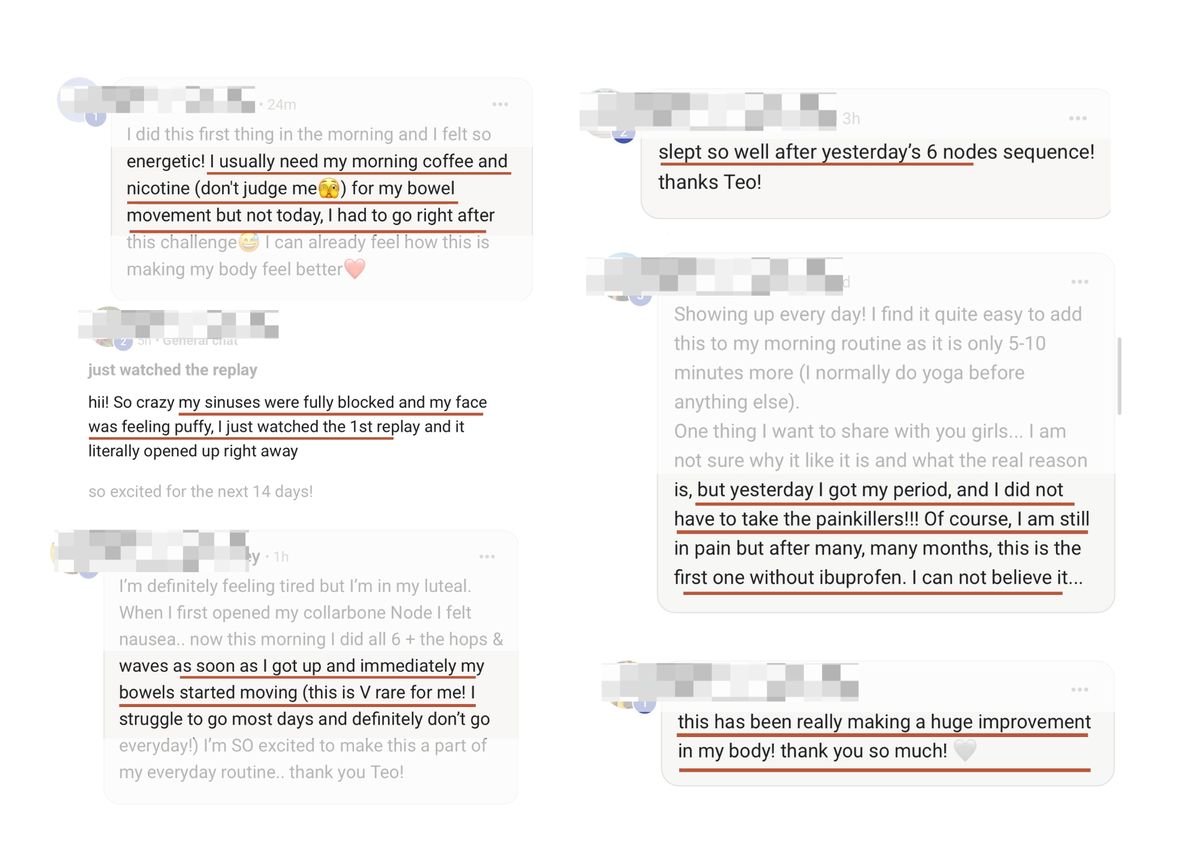
This is the shift I want you to make!!!
Inflammation is your body’s signal that something isn’t clearing, not that you ate the wrong things. Your drainage is backed up, and that changes everything about where you start.
4 things to do before you change your diet
Most women spend years adjusting what they eat (I was exactly in that spot years ago!!) without asking the most important question first: can my body actually clear what I’m giving it? (yes, me… constipated for days and never sweating in saunas)
If the answer is no, it doesn’t matter what you eat because the system is backed up.
Here’s where to start.
Step 1: Start your morning with something warm
Skip the cold water and the protein shake and smoothies straight from the fridge. Start with something warm instead: a cup of hot water with lemon, an herbal tea, warm water with a pinch of sea salt.
Warmth matters here for a specific physiological reason.
The lymphatic system responds to temperature. Cold causes vasoconstriction, your vessels narrow and fluid movement slows. Warmth promotes vasodilation, vessels relax and widen, making it easier for lymph to flow freely. Think of cold butter in a pan versus warm: one sits stiff and stuck, the other moves freely. Your lymph works the same way.
Warm liquids also stimulate the gut, support peristalsis (the muscle contractions that move waste through your digestive system), and activate the parasympathetic nervous system, the “rest and digest” state your body needs to actually process and clear. Cold first thing signals alert while warmth signals safety.
This is why traditional medicine systems across cultures, including Ayurveda, Traditional Chinese Medicine, and European naturopathy, all emphasize warm drinks in the morning. This isn’t trend, it’s actual physiology.
Start with something warm, before coffee, before food.
Give your system the signal to clear first.
Step 2: Move your body in the morning
Your lymphatic system has no pump.
Read that again…
Your heart pumps blood automatically but your lymph doesn’t work that way. The only thing that moves lymphatic fluid is muscle contraction and movement. When you move, you pump and when you sit still, the system stagnates.
10 minutes of movement in the morning, before you do anything else, activates drainage more than an hour of movement later in the day. It doesn’t need to be intense: a walk, some light stretching, gentle jumping. The point is to get the fluid moving while your body is still in clearing mode from the night. This is one of the highest-leverage things you can do for your health, and it costs nothing! ZERO!
Step 3: Fix your elimination
This is the one nobody wants to talk about so we’re going to talk about it.
If you are not having a bowel movement every single day, waste is recycling through your system.
Your gut is a major exit route so when it’s slow, everything that was supposed to leave your body doesn’t. Hormonal metabolites your liver broke down and sent to the gut for elimination get reabsorbed and waste that was processed and packaged for removal just stays, and your body, managing the backup, becomes inflamed.
The best clinical tool for assessing this is the Bristol Stool Chart.
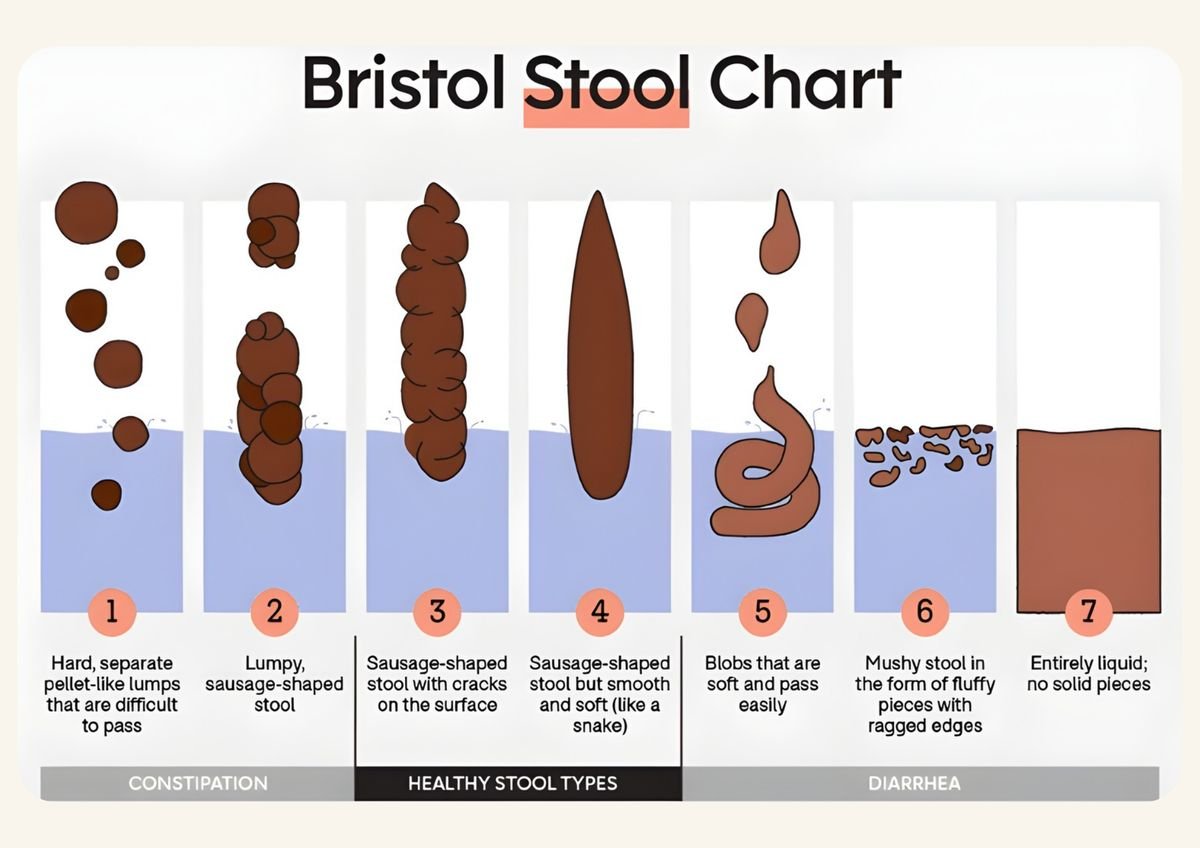
Types 3 and 4 are what you’re aiming for: smooth, well-formed, easy to pass. Types 1 and 2 mean your transit is too slow, waste is sitting too long and your body is reabsorbing what it was trying to eliminate. Types 5, 6, and 7 mean things are moving too fast to absorb properly.
If you’re not there yet, your warm morning drink and morning movement directly support this. Add fiber, focus on hydration, and reduce your stress load, which is exactly what the next step is about. And start taking it seriously! It matters more than most things on your supplement shelf.
Step 4: Teach your nervous system that it’s safe
Cortisol is the great inflamer.
But when most people hear “reduce stress” or “rest more” they picture a week-long retreat or a complete life overhaul.
This is about teaching your nervous system SAFETY through small, physical, consistent actions.
- Walking a little slower instead of rushing everywhere
- Eating your meals without a screen in front of you, without the pressure of a packed schedule
- Actually eating slower
- Taking 5 minutes for yourself after you eat instead of jumping straight back into work
- Doing things that genuinely recharge you, not productive things, not optimized things Just things that make you feel like yourself
Your nervous system needs real, physical evidence that the threat is gone before it will shift from fight-or-flight into rest-and-digest. Rest-and-digest is the only state in which your body can actually clear.
This is not about being passive or static, and it’s not about doing less. It’s about being intentional with the signals you give your body throughout the day.
Your body doesn’t know the difference between a work deadline and a physical threat. Chronic urgency, rushing, overloading, eating fast, never fully stopping, keeps cortisol elevated and keeps your clearance system offline.
Small things, done consistently, change your baseline. That’s what this step is asking for.
One more thing before I let you go.
You might be wondering: “okay, but where does all this lymph actually go once you drain it? It has to go somewhere, right?”
That’s a whole other post, and I promise I’m writing it… Subscribe below so you don’t miss it, it’s one of the most eye-opening things about how your body actually works.
Here is the bottom line
Supporting your lymphatic system should not feel like a protocol. It should not be another thing on the list, another non-negotiable, another practice you have to white-knuckle into your morning. Ideally, it would just be life. Movement woven into your day, hydration that happens naturally, a nervous system that gets to rest and reset, a body that moves enough that the lymph never gets the chance to stagnate.
That is how we were designed to live.
But we do not live that way anymore.
We sit for most of the day.
We move in concentrated bursts and call it exercise.
We are exposed to more environmental toxins than any previous generation, through our food, our water, our air, our skincare, the surfaces we touch. And then we wonder why our bodies feel backed up.
So yes. In the beginning, it will take deliberate action.
But here is what I want you to hold onto: the goal is not to be disciplined about drainage forever. The goal is to do it consistently enough, and for long enough, that your body rebuilds the capacity it was always supposed to have. Until the movement, the hydration, the stillness, become so habitual that they stop feeling like effort.
That is when the body starts to maintain itself.
You are not signing up for a lifetime of work.
It’s just a season of rebuilding.
And on the other side of it is a body that finally feels like home. And you will finally feed good in your body every single day not only on the days when hormones “are in your favor”.
Start there
Love, Teo
PS: If you want to put this into practice, come join us inside the 🔗community on Skool. We run regular live challenges where we do the drainage work together as a group. There is something about doing this work alongside other women that makes it land differently. You see someone else showing up on a hard day, and it pulls something out of you too.
← Back to all articles